 | |
|
Chem Trails Disclosure Project 911- September 11 CIA Running Drugs New World Order Genetically Modified Food By William Cooper Pharmaceutical Patent Office Oil Subjugation Depleted Uranium Global Warming Propaganda Free Energy Honor Dishonor Vaccines Fluoride |
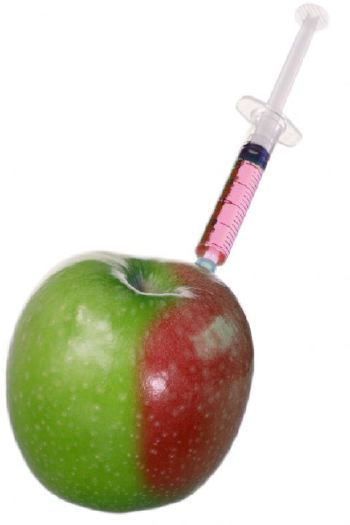
Genetic engineering is technology which enables taking a specific gene from a cell of one kind of organism and places it into the cell of an unrelated organism.What does GMO mean?
Genetically Modified Organismis the most common usage (though 'manipulated' or even 'mutated' might also be appropriate!) The acronyms GEO (Genetically Engineered Organism) or simply GM or GE are also used.
GM Food is can destroy our health and ecology
Genetic engineering is a radical new technology that forces genetic information across the protective species barrier in an unnatural way. Why be concerned? 19 Studies Link GMO Foods to Organ Disruption One of many good reasons is that these laboratory-created mutations are unlabeled, virtually untested and on grocery shelves everywhere. Not to mention - Introduction of genetically modified organisms into natural environment. May increase the use of pesticides for agricultural use. (e.g. Roundup and Roundup ready crops) Development of an organism that would cause ecological or health problems for humans .Development of food allergies to Genetically Modified crops. There are many other dangers listen on this page.
Panacea has detailed why organic raw food nutrition and organically farmed growing methods are needed to prevent the negative health and environmental effects of GM food and irradiated food.There still needs to be legislation and education in this equasion to ensure we rid our selfs of the dangers of genetically modified food, Pesticides Exposure AND irradiated food. Therefore a holistic soluton lies in the legal eradification, education and perservation of the bio - diversity. An EDUCATED public choice for organically farmed produce is needed. GM AND irradiated food is not only a CRITICAL health issue , it is a civil rights issue which continues to effect many famers.
Obama Admin preventing organic farmers with HR875 and S425 Farm Nationalization
Organic and Small Farmers and Ranchers; Natural Food Products Farmers Under Attack.The Obama administration is pushing farm controls through Congress as fast as possible and has coordinated the bills so there will be no debate and the committee meetings are closed. There are less than two weeks to stop the farming bills, H.R. 875 and S. 425. could put organic farms out of business. The group Democracy in action writes that the new "food safety"bills before in Congress were written and sponsored by big agri companies like Monsanto, Cargill, Tysons, and ADM.
The USDA would be given the power to force organic farmers what to feed their animals, how to medically "treat" them and what toxic "sprays" to use. There would be penalties beyond the ability of most small farmers to pay. There are buried regulations in the bills which criminalize all aspects of farming by listing them as "sources of seed contamination". Farmers would be forced to use only approved seeds. They could be forced to give up a good seed cleaner and put in a building and equipment for a million and half dollars. These bills are set to industrialize all farms and force farmers to buy chemicals and drugs and face $500,000 penalties if they refuse. it has been reported that HR 875, was introduced by Rosa DeLauro whose husband Stanley Greenburg works for Monsanto. - More Information
Genetically engineered food ingredients like corn and soy, as well as sugar from GMO sugar beets, are now found in thousands of grocery food items. Very strange strands are surfacing which are changing the ecology including Monsanto's aluminum resistant plants.
The Monsanto public relations story about genetically modified organisms (GMOs) are largely based on five concepts.
All five are pure myths—blatant falsehoods about the nature and benefit of this infant technology. The experience of former Monsanto employee Kirk Azevedo helps expose the first two lies, and provides some insight into the nature of the people working at the company-Monsanto The Poster Child of Corporate Manipulation Corruption and Deceit
Adding to this there is no security in place to ensure the policing of the FDA's reports. At this time any "conflict of interest" can occur, we have seen this occur over and over with the pharmaceutical industry. The public's knowledge regarding the dangers of GM food can be "interfered with" in exactly the same way.The truth about GM must be available to the public. Yet organizations like the FDA are making every effort to prevent the public from knowing the truth about GMOs in their foods. The FDA have claimed that requiring GE foods to be accurately labeled would be "confusing" to consumers.
The upshot is that they have no intention to require mandatory GMO labeling of food products, and in fact the FDA seems committed to making sure consumers are left in the dark. Conflict of interests and no "informed consent has happened COUNTLESS times with psychotropic drugs and many others. Yet these history lessons continue today to not be taken in and preventative measures have not been applied.
Before the FDA decided to allow GMOs into food without labeling, FDA scientists had repeatedly warned that GM foods can create unpredictable, hard-to-detect side effects, including allergies, toxins, new diseases, and nutritional problems. They urged long-term safety studies, but were ignored.-Source
A digital signature for a corporation charter to ensure no conflict of interest and informed consent must occur in the FDA with the education on GM's and the pharmaceutical industry can prevent these problems. (Link below).
Panacea recommends the NaturalNews Insider Alert e-mail newsletter to stay frequent with warnings and news reading this issue. Radio, TV shows Blog's, websites ,articles, videos, music and public word of mouth is needed at the very basic level to raise public awareness about the dangers of GMOs.The say no to GMO's website is a great starting point for info and affirmative action.
A particular individual Jeffrey Smith executive director of the non-profit Institute for Responsible Technology (IRT) has been instrumental for about 15 years helping to protect you from the dangers of genetically modified foods. This is all done on a show string budget.
If you cannot contribute to the educational program, a digital signature cost nothing and it is at the very basic level going to effect change.We have an educational problem. We are literally fighting for our long-term survival here. If we hope to maintain biodiversity among the seed supply, protect farmers and prevent consumers from being harmed by the negative side effects of GMOs, we need to defeat the GMO agenda right now.
To do it, IRT is implementing a plan to create a tipping point of consumer rejection of GMOs, to force them out of the market.Since GM ingredients offer no consumer benefit, as little as 5% of shoppers avoiding them could be sufficient to turn the tide. Concerned citizens already kicked GMOs out of European brands, and informed consumers can do it America and other countries as well. IRT educates people about the health dangers, and provides them with Non-GMO Shopping Guides.
Four simple ways mean time
1. Buy Organic - Certified organic products cannot intentionally
You can also help by showing the documentaries, interviews and articles listed on this page and to establish local and national Non-GMO Working Groups to educate the public, parents, schools, healthcare professionals, and others to stop buying high-risk foods that use GMO ingredients.
That effort takes funding, and you can probably already imagine such funding isn't being offered by many corporations.If we are to be successful in halting the scourge of GMOs, it's really up to you and me. We must be the support that keeps the non profit GM organization like the IRT going. Together, we can win this fight for our food freedom and help protect future generations from the travesty of GMO seeds and crops. -Action Tool Kit
GM SEED IS TAKING OVER OUR NATURAL FOOD SUPPLY GM plants proven to be POISONOUS - killing insects, birds, butterflies, and destroying our Eco System And slowly killing animals. Tests found alien GM material in honey from beehives two miles from a site where GM crops were being grown under government supervision. It is believed to have been carried there by bees gathering pollen in the GM test sites.
FARMERS AND PLANT NURSERIES TO BE WARNED. not to accept the USA rhetoric and junk false science. Tests confirmed that GM material in the honey could have come only from oil- seed rape grown at Wester Friarton, in Newport-on-Tay, by Aventis, one of the world’s biggest biotechnology firms. The fact that the GM material travelled such a distance makes a mockery of the government’s 50m-200m crop-free “buffer” zones that were created around GM sites to protect neighbouring farms. Critics have claimed that the GM crop trial sites are too close to other farms. America has buffer zones of up to 400m, Canada up to 800m, and the European Union recommends a 5km (three-mile) zone for GM oilseed rape.According to Reuters, Bulgaria's parliament voted on Thursday to tighten a law that effectively banned cultivation of genetically modified (GM) crops for scientific and commercial reasons in response to public fears.
A genetically modified organism (GMO, also called "genetically engineered") is a plant, animal or microorganism (e.g., bacteria) that is created by means which are not naturally occurring. Genetic engineering involves crossing species which could not cross in nature. For example, genes from a flounder (a cold water fish) have been inserted into strawberries and tomatoes to make them less susceptible to cold. Currently 13.3 million farmers- 90 percent of all who farm in developing countries- are currently planting biotech crops.While the Food and Drug Administration insists that foods produced by genetic engineering are the same as foods from traditional breeding, their own scientists have reported that, "the processes of genetic engineering and traditional breeding are different and... they lead to different risks."
The dangers of contamination from Genetically Modified (GM) Corn, with a showcase of indigenous corn based culture and food sovereignty is threatened in Mexico by Monsanto. Countries all over the world see the dangers of GM corn but Australia is allowing it to be grown. - When are the State and Fed Government going to remove the TGA's (UN Trade Agreements) that are killing our wildlife, and destroying our BEES.
GM Contaminated maize will result in a serious threat to the biodiversity of the native open pollinated CORN species, because, "genetically-modified crops have the potential to cross-breed with native and natural crops, altering the evolution of the entire population" and future supply of CORN.Military are co-partners as high-tech intruders in every Country. using techniques by US UN NWO geographers mapping regions with GPS and data processing technology but failing to reveal their connections with the US military or their covert use of Pentagon contractor Radiance Technologies to infringe on our sovereign rights. And geographers with geo-piracy are stealing the traditional knowledge of the indigenous communities.
As belligerent Monsanto agents use covert activities to contaminate crops, then sue the farmer for using their patented seeds sending them bankrupt and then thrown off their land - GROWERS ARE URGED to send Statutory Declaration warnings to Monsanto, and then TO DISPLAY SIGNS THAT SHOW. "MONSANTO KEEP OUT OR FACE CRIMINAL PROSCECUTION and crop damages
"Millions Against Monsanto Campaign"
Antibiotic treatments are useless to humans who have been exposed to GM foods - Codex Alimentarius will promote GM plants.The tests will bring pressure on Aventis, which was accused of a “serious breach” of regulations earlier this year after GM trials in 12 sites were contaminated with antibiotic genes. These are controversial because of the danger of gene transfer to bacteria in animals and humans, who become immune to common life- saving antibiotics.BESIDES GM FOOD CONTAMINATES; Common Garden Chemicals are also killing our BEES and causing deformed babies.
Dozens of families in Britain and America, whose children were born with microphthalmia (small eyes) and anopthalmia (no eyes), are suing DuPont, the American-based chemical giant. They blame exposure during pregnancy to the chemicals benomyl and carbendazim, which are found in Benlate, a common DuPont garden spray. The court claims follow a landmark decision two years ago, when a Florida court ordered DuPont to pay $4-million (US) in damages to Johnny Castillo, now six, who was born without eyes as a result of his mother's exposure to Benlate during pregnancy. Benomyl is the active ingredient in 11 fungicides sold in Canada, including various forms of Benlate. The seven Ontario children were born with bilateral anopthalmia, meaning they are missing two eyes.
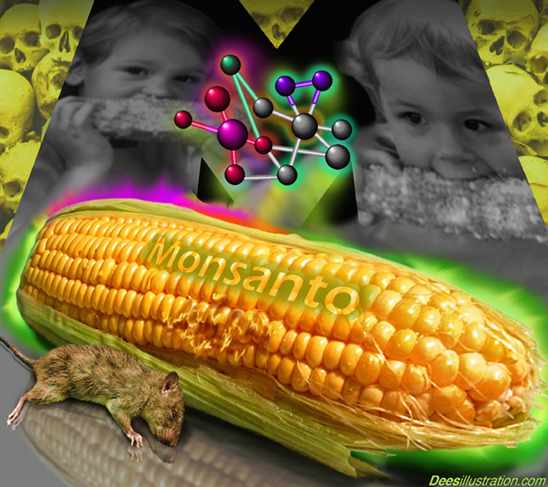
Many independent documentaries have shown the corporate company Monsanto's greed by the deliberate patenting of whole species of life forms, creating GMO crops that pose hazards to human health, threatening farmers with lawsuits if one of their patented gene sequences makes it into their crops, and much, much more. Monsanto is an UNREGULATED company that has brought us everything from Agent Orange to DDT to Aspartame, and now they control of all the vegetables on your kitchen table. Independent documentaries have shown alarming facts and with out them the counter productive health effects would be left un investigated.
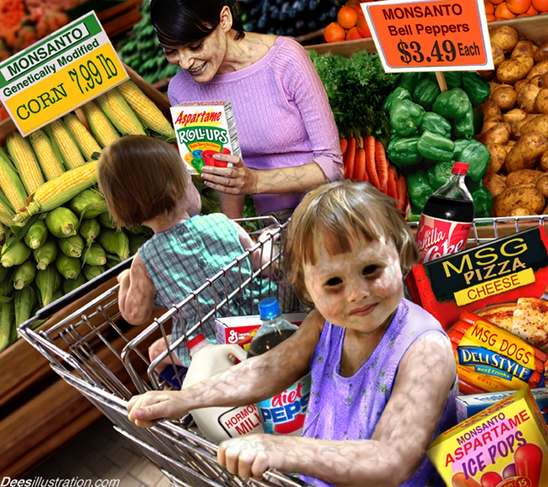
The majority of the general public will not be aware that GM food, food additives and artificial colorings ARE dangerous.The European Food Safety Authority has been studying the effects of these products and has uncovered a host of potential problems with their usage, especially in the developing bodies of children. Experts agree that most of these questionable food colorings and additives must be banned. For example aspartame and MSG.Most do not even know of the additive MSG, the name its is hidden under and the lab confirmed tests which show its dangers. More links to additive alert pages and information is also included below
Codex Alimentarius this is a petition to gather 1 million voices against the codex alimentarius, a law that will be imposed in december 2009, if we don't do anything against it. This law states that:
- all biological food must be irradiated
The ELIANT campaign together with other campaigns are collecting a million signatures in order to file a protest against this law at the european court of justice. A number of signatures above one million will enable us to do something on a european level. At this moment we still need at least 260.371 signatures to reach our goal... yours could be the One. More information and online signing at- eliant.eu
A Silent Forest - The Growing Threat of Genetically Engineered Trees
This award winning documentary film explores the growing global threat of genetically engineered trees to our environment and to human health. The film features renowned geneticist and host of PBS' The Nature of Things David Suzuki, who explores the unknown and possibly disastrous consequences of improperly tested GE methods. Many scientists and activists are interviewed in the film, which serves as an effective and succinct tool for understanding the complex issue of GE trees. The film includes the testimony of many experts on the subject and serves as a valuable tool to inform students and those interested in environmental issues.
The film has been well used in public forums, government as well as college and high school classrooms. The film includes an interview with Percy Schmeiser, who lost the rights to his own crops to Monsanto, when Monsanto seeds contaminated his fields. As Schmeiser says in the film:"It doesn't matter how it gets there, destroying your crop. All of your crop, becomes Monsanto's ownership and they can lay a lawsuit on top of it against you. Even if the contamination rate is 1%, all your other 99% of your crop goes to Monsanto. And that's what startled the world, how farmers can lose their rights overnight, an organic farmer can lose his seeds and his rights overnight, and get subject to a lawsuit."The film shows how farmers like Schmeiser and indigenous people may lose their way of life and belongings in the face of new biotech friendly science and legislation.
A new documentary was aired on French television - a documentary that Americans won’t ever see. The gigantic bio-tech corporation Monsanto is threatening to destroy the agricultural biodiversity which has served mankind for thousands of years.
The REAL Reasons You Want to Avoid Genetically Modified Foods
The health implications, government policies and push towards globalization are all part of the reason why many people are alarmed by the introduction of genetically altered crops into our food supply.Shot on location in the U.S., Canada and Mexico, THE FUTURE OF FOOD examines the complex web of market and political forces that are changing what we eat as huge multinational corporations seek to control the world's food system. The film also explores alternatives to large-scale industrial agriculture, placing organic and sustainable agriculture as real solutions to the farm crisis today.Web site.
John Mackey and Michael Pollan discuss the future of food at Whole Foods Market and the organic food industry.
Worldwide only a handful of idealistic scientists are defying industry, doing independent research on the effects of transgenic animals and plants on the environment and our health when we consume genetically modified food.
GM crop plants are also being developed to produce their own pesticide. This is predicted to cause the rapid appearance of resistant insects. Worse still, such pesticide-producing plants have already been shown to kill some beneficial predator insects as well as pests.
We are also told that GM techniques will help to 'feed the world'. This is a fundamental concern to all of us. But will the companies controlling these techniques ever be able to achieve what they would regard as a sufficient return from selling their products to the world's poorest people? Nor do I believe that the basic problem is always so simple.
Genetic engineering enables scientists to create plants, animals and micro-organisms by manipulating genes in a way that does not occur naturally.These genetically modified organisms (GMO) can spread through nature and interbreed with natural organisms, thereby contaminating non 'GE' environments and future generations in an unforeseeable and uncontrollable way.Their release is 'genetic pollution' and is a major threat because GMOs cannot be recalled once released into the environment.
We believe:GMOs should not be released into the environment as there is not adequate scientific understanding of their impact on the environment and human health.
The World According to Monsanto, A documentary that most Will never see.
The gigantic biotech corporation Monsanto is threatening to destroy the agricultural biodiversity which has served mankind for thousands of years.The endless list of genetically modified seeds sold and controlled by Monsanto are putting at enormous risk age-old agricultural patterns under the presumptuous slogan of aiming at solving the huge problem of hunger in the world.
On March 11 a new documentary was aired on French television (ARTE – French-German cultural tv channel) by French journalist and film maker Marie-Monique Robin, entitled 'The World According to Monsanto' (Le Monde selon Monsanto). Starting from the Internet over a period of three years Robin has collected material for her documentary,going on to numerous interviews with people of very different backgrounds. She traveled widely, from Latin America, to Asia, through Europe and the United States, to personally interview farmers and people in influential positions.
As an example of pro-Monsanto interviews, she talked at length with Michael Taylor who has worked as a lawyer for Monsanto and also for the Federal Drug Administration (FDA), where he had great influence on the legalization of the genetically modified bovine growth hormone (BGH). It also became FDA policy during Taylor's tenure that GM seeds are declared to be "substantially equivalent to non-GM seeds, hence proclaiming proof of the harmlessness of GMs to be unnecessary. Michael Taylor is a typical example of technocrats employed via 'the revolving door policy'. He is now head of the Washington, D.C. office of Monsanto Corporation.
The gospel according to Monsanto is that their patented GM seeds and their bovine growth hormone (BGH) will increase worldwide production of agricultural, dairy and meat products and Bt cotton to the extent that worldwide hunger and poverty will be eradicated.
The actual truth is rather the opposite. GMOs are creating serious damage all over the world and artificial BGH injection in cows cause numerous health problems, and even death.
Monsanto is not held back by any considerations of ethics and it hides the reality of its sordid machinations behind a wall of secrecy. Everything Monsanto does is exclusively with the intent of increasing its own profit – everything else be damned. If left to its own devices it will most certainly destroy the livelihood of millions of farmers – a process begun a decade ago in India and certainly in many other countries as well. The planet's ecosystems will be seriously threatened by unnatural ways of changing agricultural patterns. The dangers of GMO cultivation to the environment come in many forms:
* Switching from age-old biodiverse crops that can tolerate low-level amounts of water to industrial monocultures of crops such as GM soya, cotton, sugarcane, etc. that require large amounts of irrigation.
* Inundating cultivated lands with toxic herbicides, in particular the dangerous Monsanto product Roundup, to which the GMO seeds have been made biotechnically resistant. Any other growth should succumb to Roundup, were it not for the fact that weeds to a very large extent become Roundup resistant.
* Putting an end to biological farming and poisoning non GM cultures through pollenization from GM crops and accidental exposure to Roundup herbicide.
* Deforestation to make more land available for the culture of the GM seeds Monsanto sells at high prices to poor farmers.
On top of all these dangers to biodiversity and biological farming comes the fact that Monsanto has patented its products and farmers are legally bound not to save seeds for replanting for the following year. They must buy new seeds from Monsanto every year and the company has a sizeable staff that just deals with prosecuting farmers suspected of illegally using one year's seeds for the planting of the next year's crop.
Using a combination of undercover filming and scientific analysis, Supermarket Secrets investigates whether the food on supermarket shelves is really as good as it looks, whether prices are as good as they seem and what happens behind the scenes in the production of supermarket food.
The first of the two programme features secret filming which uncovers the horrific conditions inside a chicken broiler house preparing chickens for a company which supplies all the major supermarkets. One study carried out by a professor from Cambridge University revealed that 82% of chickens bought in supermarkets had hockburns – a tell-tale sign of poor animal welfare caused by sitting in litter. Jane Moore shows how to examine chickens for hockburns.
Programme two meets the organic potato farmer who feeds much of his crop to his cows because, he says, the supermarkets deem his produce to be insufficiently cosmetically pleasing.
Interview with Christopher Cook author of "Diet for a Dead Planet: How the Food Industry is Killing Us.
They are cheap flavor enhancers that make people want to eat more of whatever the food is and so make money for the companies, and the practice of using them is so entrenched that nothing is going to change right away. A lot of known junk foods, like Dorritos and other snacks, list MSG undisguised as an ingredient, probably because if you eat that stuff, there's so much other crap in there, you probably don't worry much about it, but what really gets me are the "healthy" foods that disguise what they're really adding. That tells you something.
Monosodium glutamate (duh!!) Hydrolyzed vegetable protein Hydrolyzed protein Hydrolyzed plant protein Sodium casienate Calcium casienate Yeast extract Textured protein Autolyzed yeast Hydrolyzed oat flour
Malt extract Malt flavoring Bouillon Broth Stock Flavoring Natural flavoring Natural beef or chicken flavoring Seasoning Spices
Carrageenan Enzymes Soy protein concentrate Soy protein isolate Whey protein concentrate
The True food.org Take Action campaign Food Standards Australia New Zealand
|