|
"I'd put my money on the sun and solar energy. What a source of power! I hope we don't have to wait until oil and coal run out before we tackle that."
— Thomas Edison
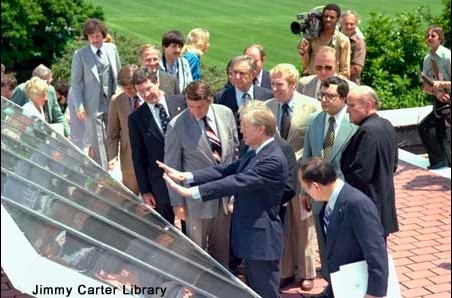
Source
Above is Jimmy Carter who put solar water heater panels on the roof of the White House. Ronald Reagan famously removed them.
Currently the government in Australia is providing rebates for those who purchase solar panels for off the grid home power usage. The average cost of a solar plan is still out of reach for the average consumer. This rebate can be put to use more effectively by a community solar net metering plan which with this rebate can be affordable.
What the public and government bodies do not realise is the following:
1) Solar panels have no federal regulation which further ensures that they are to be moderately sufficiently (reasonably) priced to allow a practical public dissemination. There is already a carbon tax in place to regulate certain technologies. The same justification and legislation can include 'fair pricing' on environmental beneficial energy systems.
2) A simple 120 watt solar panel per house hold could produce a 'net metering effect' which supplies power both back into the grid and too each of the individual house's needs. What is not used from the power accumulated during the day can be sold back to the 'grid'. This net metering program is the answer to enabling communities to access affordable solar technology to do benefit. A simple 120 watt panel per house hold with the rebate could cost as low as 200$. More Info info is included below.
3) All the money currently being offered for a rebate could be applied towards a cheaper solution by endorsing a not for profit organisation to help manufacture cheaper solar sterling engines using parabolic dishes which are more efficient then solar panels.
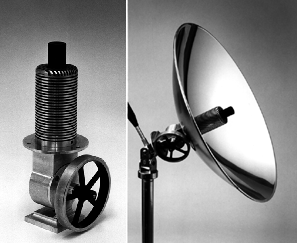
A Solar sterling engine
Cheaper and more efficicent then a soalr panel
There are also low cost open source designs which could be produced to allow EVERY consumer to afford a solar sterling engine for the net metering scheme to become a reality.More informaiton on solar sterling engines using a parabolic dish has been included below.
4) Panacea is such an environmental not for profit organisation which could help this effort if given grants or the revenue reserved for such rebates and make this revenue go 'further'.
5) There is enough energy in one Australian summers day to supply the whole earths energy needs for half a year! All the worlds energy needs are already provided by the solar grid, yet the infrastructure is not there to utilize this free energy.
Panacea will now present facts which justify a not for profit organisation to implement the solar 'net metering system.
The Net metering system is the answer to enable residents to start with affordable Solar technology. As of 2009 an average solar panel (still overpriced) is at 900$.If the rebates were re directed towards a solar NET METERING plan, an average 120 watt solar panel could come down to as low as 200$.
This is far more realistic for the average house hold to afford. As a result of this net metering plan, each year (or in 4-5 monthly installments) the house could accumulate another panel at low cost and build upon it towards all combined collecting more and more solar panels/power for themselves. But the benefits do not stop there.
If one community each had a 120 watt solar panel per house, this could not only take care of a majority of their power accumulated during the day but all combined could add up and go back into the gird.
Add up the power accumulated from a 120 watt solar panel per house in a local community per hour. Some people will be at work and will not even use it during the day. This power can be taken off their bill and any excess be sold back to the grid or power companies.
By starting this solar net metering plan at low cost it gives communities the opportunity to afford and collect solar panels and all use them combined for the greatest efficiency.
Background on net metering
The electrical power grid is a study in organizational behavior. Take how electricity is generated and distributed to the point of consumption. Huge power plants or arrays—fueled by “green energy” sources such as solar, wind, biomass, geothermal, and hydroelectric, or “brown energy” sources such as fossil fuels and nuclear—concentrate electrical power generation to take advantage of “economies of scale.”
The resulting current is transmitted through an extensive redundancy of power lines, cables, substations, circuit breakers, switches and transformers—oftentimes referred to as the “power grid" —to individual consumers across wide areas.
Organizationally, this is a centralized model. Power is concentrated in a select number of locations and authority is distributed to other points as needed and according to priorities driven by limited supply during periods of peak demand. The overall system, no matter how inefficient or costly, strives to be convenient, available when needed, standardized in delivery, and transparent during use.
The goal is to please the most and dissatisfy the least so that fundamental assumptions about the design of the system are unquestioned, significant investments in infrastructure modernization or extensive system redesign are delayed, and increases in operational costs, along with services, are passed fluidly to the consumer.
In other words, the existing power structure prevails and remains unchallenged and the consumer is dependent on that structure to get what is needed and wanted.For every movement, there is a counter-movement. There are those who regard being “on the grid" as a lifestyle that epitomizes wanton consumerism, promoting waste, excess, banality, and destruction of the environment.
Their alternative is to live “off the grid” disconnected from public services including electrical power. Initiated during the 1960’s and ‘70’s, the “back to the land” movement is often synonymous with off the grid solutions such as energy from solar, wind, and biomass sources.
The off the grid approach represents an alternative organization structure—a decentralized model. In this instance, power is held by a wide range of relatively small, independent individuals / families who are in total control of an electrical power system that meets their consumption requirements. As with many decentralized structures, one’s destiny is in one’s hands. However, the limits of these structures become apparent when consumption patterns change and more power is required or disaster strikes and there is no opportunity for a quick recovery.
Over the weekend, the article, “Solar homes can make so much energy that meters run backward,” was posted on the My San Antonio website. As the title suggests, some homes with photovoltaic (PV) panels generate sufficient electricity during the day to meet and exceed the immediate consumption needs of the home. In a different twist to back to the land homes sporting off the grid solar powered systems, the homes in this article were definitely on the grid and used that connection to load surplus electrical power onto the grid and receive financial credit for doing so through a process called, net metering.
While a national mandate for electric power companies to offer fair net metering practices is not in place—albeit, some writers, Jay Draiman of Northridge, CA, tout this as a necessary step in overcoming our dependence on fossil fuels, momentum is gaining in several states as commitment to renewable energy is strengthened. One of these is New York where, as the article mentions, the New York Energy Research and Development Authority (NYSERDA), launched the New York Energy $martSM initiative which offers a range of incentive programs directed toward offsetting the installation costs for small-scale solar systems and encouraging connection to the public power grid in order to facilitate net metering.
From an organizational standpoint, this represents a very different structure—the integrated model. Although neither centralized nor decentralized, integrated structures blend a centralized surplus distribution and backup system with a decentralized network of small-scale operations.
Such interdependence distributes responsibility and authority to individual members in the social system so they can engage in self-sustaining behavior patterns while linked to a broader network of resources and markets.
Individuals are in control of investments, operating expenses, and utilization of resources. They can take care of themselves first, sell the surplus, or if circumstances warrant, buy what they need or want when they are unable to provide enough by themselves.
The combination of electrical power grid, PV panels, and net metering represents one way developments in technology influence organization structure and design. As systems technologies become more powerful, pervasive, and transparent, sub-systems will become more embedded, integrated, and interdependent. The same concept applies to computers, the Internet, and payment for posting articles on a website or blog.
As information and communication technologies continue to evolve, they will empower individuals to THINK independently, work openly and in parallel, and collaborate when opportunities arise for bargains and balances to be struck among the various comparative advantages, surpluses, and deficits in the larger system.
Thereby comes one of the unintended but inevitable consequences of pursuing “green energy” sources for power generation in lieu of “brown energy” sources: the fundamental organization structure and assumptions for organization design shift. Control is no longer held by a central body, be it a corporation, government, or special interest group; nor is it fractured and splintered to such a degree that collective effort is no longer possible.
Instead, it is held in balance at the point where production, distribution, and consumption work in unison with one another for the advantage of the system rather than favoring the interests of a few at the expense of the many. Conventional wisdom may differ, but the world will be a better place for it! Posted by Steve Bosserman on Wednesday February 7 2007. Link
Net Metering can also be extended to include small scale wind mills.Here is a quote from the Boswell turbine web site describing a net metering plan possible with a wind mil.
If, at any point during the day you need more than what the B800 or B1500 provide, then you pull from the grid. If you need less than that, you send power back to the grid. Depending on your usage, at the end of the month, your power company will probably owe you for the net amount you've sent back to them. Most homes could get ahead with just a 2,000 Watt generator, and this one produces 3 kilowatts, continuously, not up and down with the weather.The best case scenario for wind generation production is "on" about 15-20% of the time on average. The best case of Sun energy is 1/3 of the 24-hour day, and a comparable output of 3 kw, is going to cost $30-40,000 installed. When weighing the $5/Watt installed price for the B800, remember that this generator is steady, continuous output. No up or down; just constant energy at nearly 3 kilowatts Hence the quicker return on investment.
Depending on the cost of electricity, Jim says the unit can pay for itself in just 1-2 years. Everything after that is free, if not profit from producing extra electricity. Whether the wind is blowing zero or sixty miles an hour, the unit output is the same.Jim said that he put the wind turbine in the original design as a way to self-start the system. But it turns out that the system doesn't even need that. He kept it in there, though, in order to keep the "wind turbine" classification for energy credits. Source
Solar powered sterling engines are more efficient then solar panels and cheaper to produce.
The following technology can also be substituted for solar panels and is not only more efficient, but cheaper to manufacture. This technology can also be implemented in a solar net metering program.
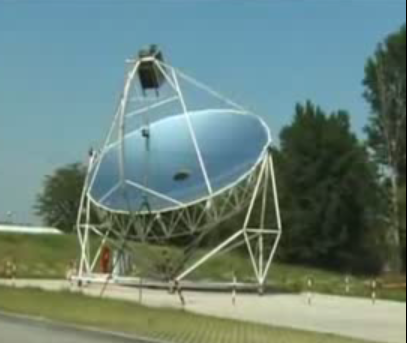
The Solar sterling engine
Investigations in to the utilization of solar radiation by means of Solar Dish/Stirling Power Systems are being carried out at a number of sites. Using concentrators constructed with multi or single facet curved glass mirrors or stretched membrane mirrors.This is a technology that dates back to the 1870s and the pioneering work of John Ericsson. A look at a model solar dish/Stirling.
The alternative to expensive solar dishes is to use a flat plate solar collector. Also a Solar Chimney Power Plant is possible .For a comparison of the different types of focusing systems look at:
energylan.sandia.gov parabolic trough
energylan.sandia.gov solar dish
solarpaces solarpaces fresnelook
Links to other Solar web sites
Currently this Compnay has offered to take the rebate offered by the Australian government and install solar panels. How ever this offer merely supples a 200$ savings per year.
This is obviously the least efficient way of utilizing the 8, 000 rebate offered. Obviously the government and the public are not aware of the net metering plan benefits which would make their life cheaper and sustainable.
Once the proposed granted Panacea research and development centre is funded, Panacea will pledge to under go a solar netmetering educational plan as referenced in the above article.
Additionally a notable example of technology which can use solar more efficiently then any other can be found in the solar test of the Joseph Newman Device.
Link
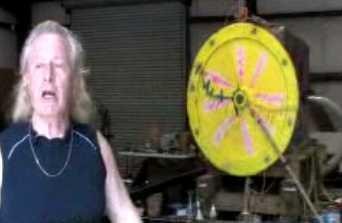
This video shows something which has never been done before. A 7,500-lb Newman energy machine with a 1,200-lb rotary and a 450-lb flywheel which is spinning at hundreds of rpms.
This is powering a 375-lb positive displacement pump with a 4-inch diameter intake/out-take & 10-foot head.
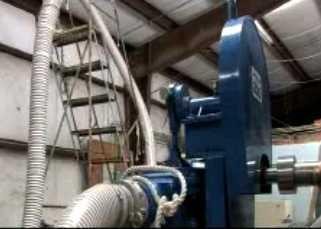
This is pumping 5,000 GALLONS PER DAY is running off only: 4 SOLAR PANELS that can produce a MAXIMUM OF JUST UNDER 120 WATTS (up to 400 volts x .287 amps)!!!
This device can amplify the power of solar systems more efficiently then any other device in the world. This solar system can provide more effective power from cells and critically needs implementation and faculty awareness.
Current solar systems are expensive. The cost to solar power a home in Australia averages out at $25,000 to $30,000 and the return on capital takes 15 to 20 years.
The major political parties in the recent election are all pushing for clean green energy and we can go solar. It is way out of the reach of the average householder and it shouldn't be. At the last election Mr.howard offered a green package and was going to pump $500 million into developing alternative energy R & D. Whatever happened to that and what was the result?
We have the ideal climate for solar in Australia but few can afford to take advantage of it and the government won't assist. The rebate they offer is a pittance and if you want to sell back to the grid, the paper work is a nightmare.14 pages of it. Surely we can do better than this and the target should be to at least to halve this cost and try to reduce from there.
To support solar panels at cost and the net metering plan please contact Panacea. Please help by forwarding this information to your local parliment member or local congresssmen.
Links
Web Hosting Green, Servers Powered with Solar Panels
Enviromission.com.au
For those who wish to get DIY information and technical support on solar home power projects or other renewable energy systems, please visit the discussion board of the following site:
http://www.otherpower.com/
|